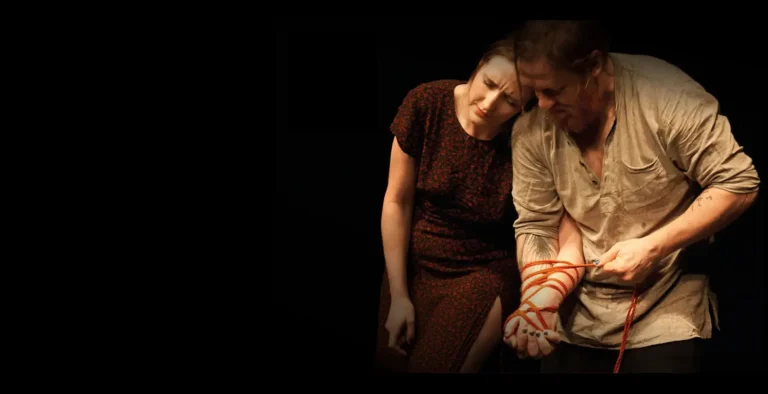
Archimedes, Elephant, and Peter Pan –

Or the question whether Kinbaku is Aristotelian.
In former considerations about Kinbaku my other fields of interest basically always moved me in the direction of linguistics, as it seems quite convenient to interpret all the different events during a Kinbaku scene as parts of a conversation – a dialogue, or to be precise, an interview. It was somehow easy to draw the parallels between spoken language and tying language.
This time though, it seems, I need to move into a new direction. One that appears so odd, so unnatural that I myself, must giggle a bit. I want to invite you to the lands where poetry meets physics. It is the region where there still seem to be so many white spots on the map that it is worth exploring it. I’m speaking of the wonderful world of the term ‘move’ (bewegen). Every time a polyseme appears with the same double meaning in different languages, I get curious. To be moved (bewegt sein/bewegt werden) and to move (bewegen).
Before we depart to that wonderful world, I want to pack a thing without which we have no interest in going there. This thing appears in my former writings. It is nothing but the genuine wish of causing a blissful movement of the heart of my partner.
So far, my considerations around the interview metaphor have helped understanding how to listen to the tied person in a Kinbaku scene and thus moving their heart. This time we want to work just with the related double meaning of ‘move’.
How shall we move someone’s heart other than through honestly being interested in their personality? The idea is to switch the meaning back and forth and go for a moment away from the poetic meaning of being moved. The first place I land is the physical meaning of being moved. Someone could be moved in order to be moved, or, the movement of the heart could be caused by the movement of the body.
If that’s the case, what is moving the body? Osada Steve Sensei gave one answer to that question. An elephant is often seen as an animal which just walks no matter what is in its way. It just moves the objects which appear in its way. The elephant uses just its incredible body mass to go its way and if there happens to be something or someone, it or they will be moved. Some of you have already seen my Ranboo approach. A great many of it is the elephant who moves the tied person and it seems to work with the heart of many people in ropes. They are moved by being moved by the elephant.
Let’s let the elephant accompany us on our further way and let’s think about what else could be moving. When I studied at the University I heard that story about a person who lived a couple thousand years ago. He is considered to have said “Give me a stick long enough, a point to stand on and I will move the earth.” The person I am talking about is Archimedes who described leverage. It is this leverage that allows someone to move something or someone else with astonishing ease. My second hero of leverage after Archimedes is Yukimura Sensei who seem to have known the points of leverage like nobody else. He was it who taught me how to move my partner in order to move them.
So, here we are with the physical causes for movement – causes that come from outside the moved body. But isn’t there something else, something familiar that moves the body and hence the heart? I would say, there is. For more than 110 years now a fictional character has existed in books (1902), plays (1904), and movies (1924) with the name Peter Pan. The child who wouldn’t grow up. Millions of hearts have been moved by that story but most of them only for one reason. Because they believed in it. They wanted to follow Peter Pan through Neverland and so they moved themselves to those places of their fantasy which are their favorite ones. They moved because they believed, invited by the stories of Peter Pan.
Through my studies in Kinbaku, I found similar movements with ropes where the tying person only needs to invite the tied person to follow. No physical force moves them but the belief that if they follow they will reach their happy space. They will move physically and through that they will be moved emotionally. They will reach Neverland.
An elephant, Archimedes, and Peter Pan. Those three (I haven’t found more yet) are moving and hence moving. In Kinbaku all three movements are caused by an outer mover – the tying person. The one who ties has the power to move someone in a way that is moving. But there lies also a great danger. To be moved not only means to get one’s heart filled with bliss. The opposite is often the case and in Kinbaku, as one can read everywhere, if the outer mover has selfish motivations, to be moved can be disastrous.
The little thing we packed for our journey turned out to be a necessary tool in the land of being moved. A true and genuine wish of providing a positive experience for the person in ropes. Only then, in my opinion, the movement of the tied person’s heart can also move the heart of the tying person.
More to come on this topic, which turned out to be one of my two main fields of interest, research and practice in the last little while after publishing my book “Archaeology of personalities – a linguistic approach to erotic rope bondage”.