Thoughts on Shibari and Cultural Appropriation
The image is widespread and found in every major European or North American city. A Shibari dojo. Kimonos, kyu’s, ryu’s, kanji’s, muganawa, tea ceremonies, and debates whether Shibari or Kinbaku is the appropriate term. What is absent all too often is a Japanese person. And that absence is primarily noticed by … other white folks.
What is cultural appropriation when it comes to a practice such as Shibari? What is cultural appreciation? How can we engage in a practice that so many believe has its roots in ancient Japanese traditions? And how can we do so without stepping into a web of contextual practices and representations that undermine the agency of those who are directly and ethnically embedded in that culture?
My thoughts on this are neither an answer nor a justification. They are neither a positioning against nor for other non-Japanese practitioners who have either too much or not enough Japanese paraphernalia in their spaces and in their visual appearances. My thoughts are more like meandering through my observations and experiences. And they are informed by my own studies in Japan and of Japan. I have spent about a month per year between 2012 and 2017 in Tokyo and one trip to Hamamatsu. I have studied with Haruki Yukimura and I became friends with a Japanese couple that is internationally renowned for teaching Shibari. All of us exchanged numerous gifts over the years. And there was a time I proudly displayed those gifts in my space. Until I was told that I am culturally appropriating. Not having anything to counter I took down the displayed items only to then be asked by the gift givers why I wouldn’t put them up in my space. An impasse.
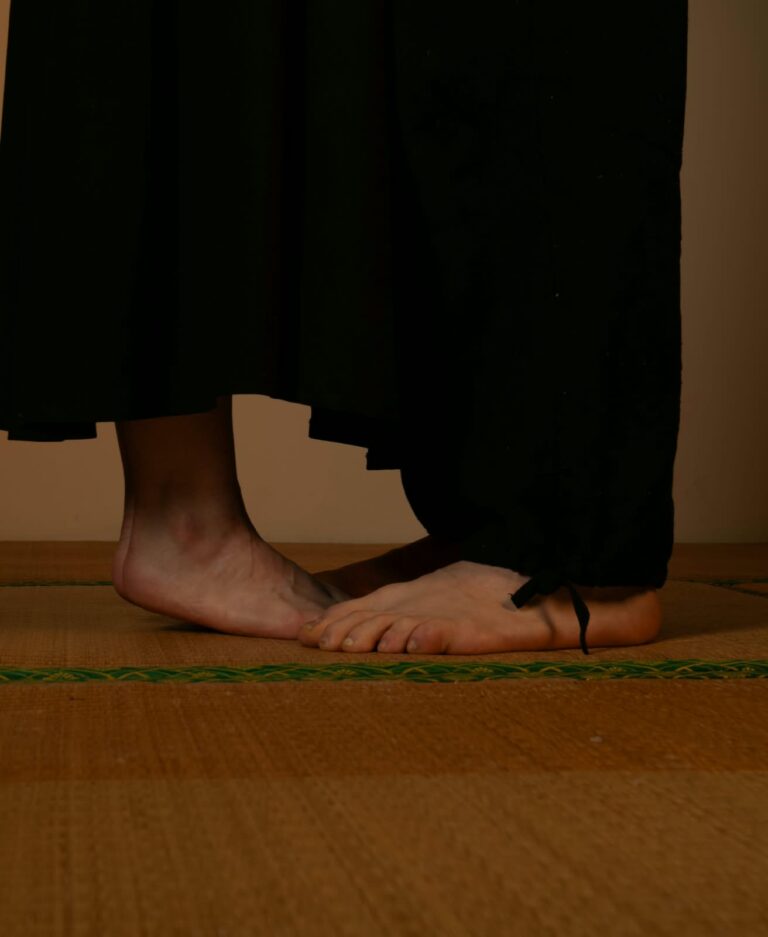
Since then, and after reopening a space “after” the pandemic, I’m still in this impasse. The last thing I want is to appear as if I was appropriating a culture different from “mine”. Thus, the space that I co-created with my two partners has almost no trace of anything inherently Japanese aside from tatami mats in one area and a door curtain that was the first ever gift from a friend in Japan.
Let’s talk briefly about the history of the practice. Shibari is often portrayed as this ancient tradition that is rooted in “hojo jutsu”, the martial art of the Samurai, and, if you want to believe one of the often-quoted books, it even goes back to a prehistoric culture some 15 000 years ago. But when you look a bit closer, it is way more complicated and not at all very traditional. Taking a broader look at the history, it is way more likely that Shibari as an intimate or kinky practice emerged in a somewhat organized form not much earlier than in the first half of the 20th century at the crossroads between art, sexwork, colonialism, nationalism, and rebellion. Ito Seyu, who is generally considered the “father of modern Shibari”, appeared to have been more interested in topics such as the aesthetics of suffering, disheveled hair, and dark fantasies. Rope was a means to an end, it seems, when studying his works. Looking at the first few issues of Kitan club magazine, Japan’s first kink publication that started in the 1950s, what is portrayed in the illustrations is most often European or American folks playing with Christian symbols. My teacher Yukimura Haruki, who passed away in 2016 used the illustrations by John Wily as his main source of inspiration. In my time in Japan, I have encountered many practitioners who used the English term “bondage” and when asked why, their answer suggested that it is fashionable to use a foreign term for it. The implication here is not that Shibari isn’t Japanese and therefore there can’t be a cultural appropriation. There can absolutely be cultural appropriation, but I am suggesting that it rather happens in the periphery of Shibari rather than at its core. That means, cultural appropriation happens in the context of the practice. So, where are the gaps through which it sneaks in? I want to tell an anecdote from an encounter I have had with a rope practitioner from Germany. Years back, we both coincidentally visited the same event in Berlin. We knew each other from previous events. In Berlin, he invited me to go for a walk through a special exhibition at the botanical garden, specifically through the Japanese section. The whole time, he explained about how this would not be in a real Japanese garden and how that would be different and so on and so forth. Whenever he went to a Shibari event, he was dressed in Samue and hakama, his tying partner wore a yukata and both wore fundoshi. They ate sushi all the time (in Germany…) and every time they tied with each other, they played a butoh playlist. Back then I thought wow they are really committed to this stuff and I felt quite awkward in their presence. At the exit of the garden there was an info table about the garden and his face turned white. The garden was designed by a Japanese star-garden-architect who had incorporated only the most traditional elements for that installation. And this same experience has accompanied me in the world of Shibari for almost 20 years now. Shibari dojo’s with Japanese light fixtures that suggest that alcohol is served at this establishment, or fried chicken. are often presented without checking what their meaning actually is. White women dressed in yukatas are being tied to the sound of a shakuhachi. There is a fixation on copying a specific cultural aesthetic and copying its specificity not only without knowing its intricate meanings but worse, also without any attempt of translation. There is a sharp contrast between appreciating aspects of a culture and appropriating it. But where is that line? One line, it could be argued, lies on the plane of colonialism. Members of a culture who has colonial “involvements” with the culture in question historically appropriated the other culture as a way of belittling, of further overpowering and of robbing the culture of its symbolic realm – something that I am painfully witnessing in Canada with the mass produced “native art”. Another line could be drawn on a more individual psychological level where a member of a culture A seeks to fulfill their fantasies by means of projecting all their longings for adventure, for stability, or for other means into a surface level interpretation of what the other culture might be. There are of course other planes with numerous lines between cultural appropriation and appreciation.
Who is the determining authority? Is it other white folks? Is it members of the culture in question? Is it a cultural scientist who specializes in the culture in question? Another question arises and I find that question to be not only academically interesting but it reaches into our everyday lives in many different contexts. What is a culture? I think the question wouldn’t be so important to me if it wasn’t several cultural scientists who exclaimed that there’s no good definition of what a culture even is. How can something be appreciated or appropriated that is as opaque as the term culture. In a way, one would probably say with confidence: “Of course I know what a culture is but if you ask me what a culture is, I have no answer.”. Sure, pinning down Japanese culture seems easy at first. But then you look closer again and it becomes blurry yet again. And still, obviously there’s the practice or the use of a certain object or piece of clothing that’s enough to raise the feeling of appropriation in the observer. But here’s the thing: the observer themselves is somewhere positioned in the social field and their observation comes from a perspective. And, furthermore, the observer has access to resources depending on their position and perspective. I would personally say that if the observer is native to the culture that has been ‘used’, they have the first call on calling the use appropriation. But it needs to be considered that a culture that is usually appropriated is also one that is in one way or another oppressed by the culture of the one who uses which means that that observer is often not in the position to successfully call out the use.
An observer who is member of the culture who is using might be in a better position to call out but their perspective demands two questions:
A: Do they have enough information to identify someone’s use as appropriation? That is, does the observer know if the object or practice or symbol is actually an item of a specific culture and does the observer know the story behind the use? A story comes to mind that contains both: I witnessed a rope performance once where the person in ropes was wearing a traditional Chinese costume and someone called them out for cultural appropriation of Japanese culture. It turned out, the seemingly white person in ropes was half Chinese and wore the clothes of their grandmother.
B: Why is the observer calling out the observed action? Is it to defend the culture in question and does it “need” defending? Or is it to put oneself into a specific position politically? What is the motivation, justification, and legitimation of calling out the appropriation?
Let’s come back to shibari, and the specifics of the cultural appropriation of Japanese culture. I have tried to establish that the practice of Shibari itself is not necessarily as established as a tradition of Japan. It furthermore isn’t just Japanese. The question of whether or not Shibari is cultural appropriation brings up another context. The refusal to engage with something that is part of another culture can be equally problematic as to appropriate the other culture when the motivation for the refusal becomes apparent. As I am writing this, a horrible anekdote comes to my mind. In Vienna, where I started tying, there was one influential practitioner who decidedly did not do shibari. He joked about it saying that he won’t do that since his “eyes weren’t …”. I guess we can all imagine the racist trope that followed. That is unfortunately not an insulated incident, and I have witnessed this side of the kink world all too often. This is obviously not a call for cultural appropriation. One could hypothesize psychologically that the racism as well as the cultural appropriation come from a similar if not the same source. Both the racist as well as the one who fetishizes cultures different from theirs view the other culture as something that is lesser or smaller or less valuable than one’s own. Still, the question of where the line between appreciation and appropriation lies remains open.
Most Japanese people I know say it’s not cultural appropriation when they see shibari being practiced by non-Japanese people. Almost every Japanese person I know rolls their eyes when they see someone bringing no understanding or curiosity or humility to the table but only tropes and cliches and badly copied aesthetics. That doesn’t mean that no Japanese person thinks that way. What that means is that the question is blurrier and more difficult than would fit in a simple and general answer.
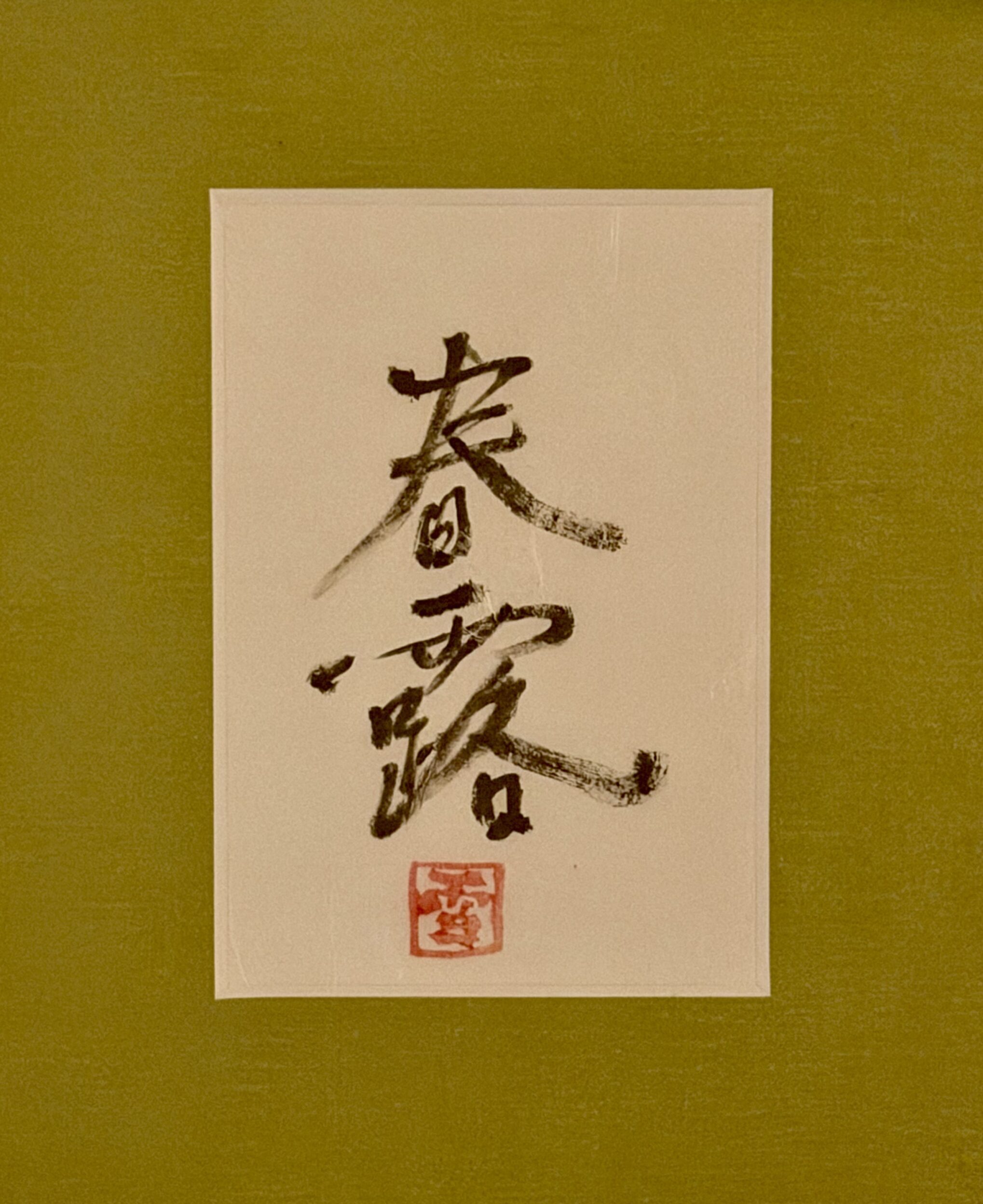
What we are doing at Studio Allegory is to educate participants and the community in ways that make people ask questions rather than telling them which item may or may not amount to cultural appropriation. We ask white folks to maybe leave out the kimono and the music, and we tell them that most Japanese terms for rope patterns are to please the brains of white folks. We tell them that the tatami mats at the studio have qualities that would be unaffordable with regular gym mats and the bamboo for suspension has properties that are nowhere to be found in the same combination. And that the calligraphy with my given name was gifted to me by Yukimura Haruki with the note to share what I have learned from him in his name.
In other words, our educational program is aimed at raising awareness and curiosity instead of ready-made answers. A lot of information in the field of practices like Shibari is neatly packaged and digestible, be it rope techniques or consent education. And the same is true for the concept of cultural appropriation. The problem with this packaging is that it leaves no room for nuance or contexts but that is exactly what all this information requires. “Il n’y a pas de hors-texte” (“There is nothing outside the text”. Derrida 1967)
Georg Barkas. 2026