
On Successfully Not Handling a Futomomo
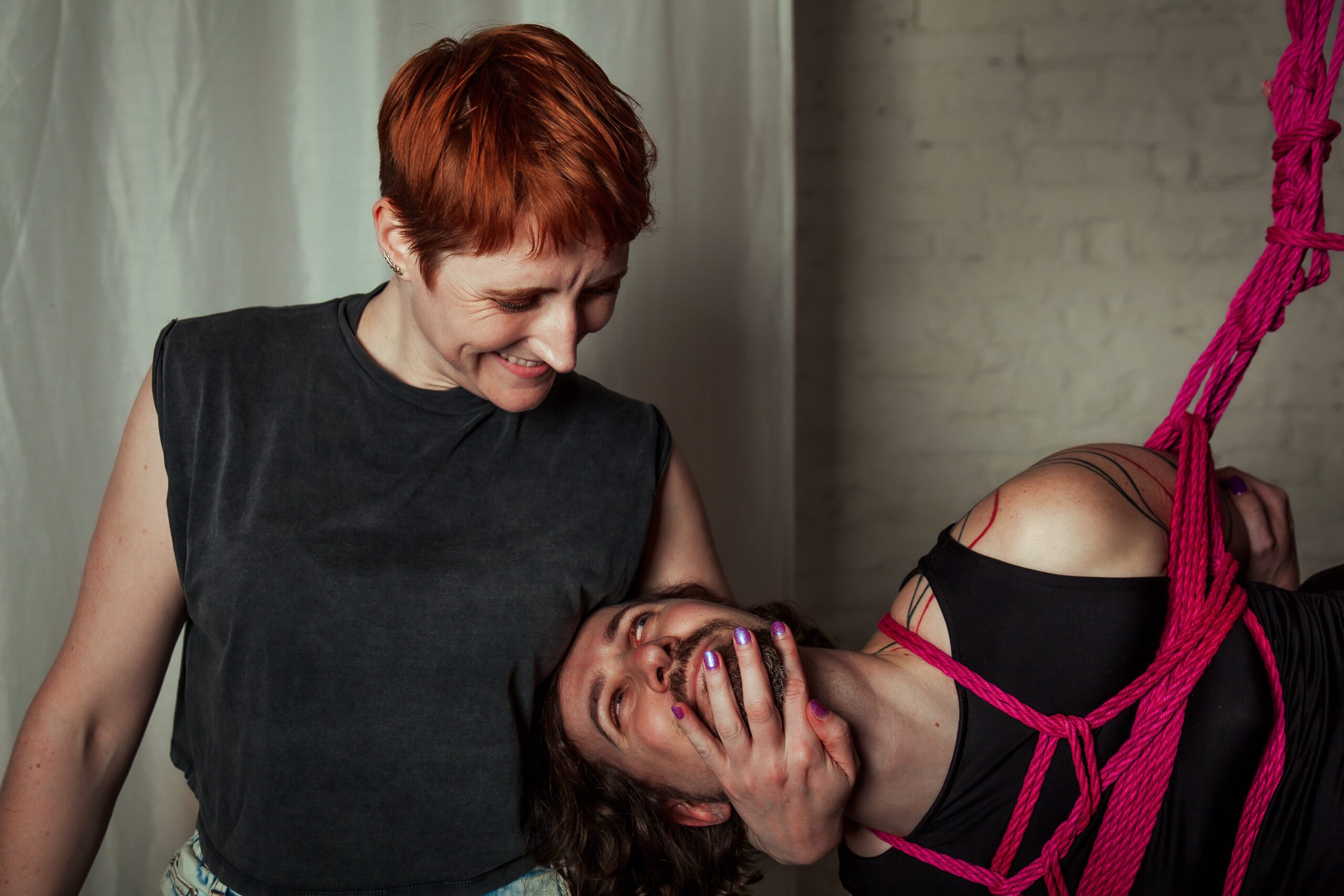
One day, while Barkas and I were teaching at Thursday class, a friend told me that it was great to see me not handle that futomomo. As she put it, she isn’t used to seeing me not rock something. And it’s true, I didn’t handle it. In fact, I folded like a cheap tent the second there was weight on it. But her comment started me philosophizing, and I accidentally wrote a thing because that’s how I’m dealing with the drop of getting a tattoo on my ribs and sternum, which sucked a lot.
So here’s the thing – when Barkas and I teach, we demonstrate things that we know work for us. We offer variations and support people to adapt and pursue variations that work for them, but when we demonstrate we (of course) demo things that work for us. We demo things we have played and experimented with a lot, ties that we know work well on my body and that make me feel good. We don’t demo things that I hate, or ties that I can’t sustain, and we don’t demo types of play that make one or the other of us uncomfortable in a way that we are not prepared to share with others (there’s shame I’m willing to let others witness, and shame that is for my partner alone). If that stuff works well for people in the class then we help them build to it, but our demos show us at our best, which we feel is only logical. Why would we show things we don’t know well? Why would we demonstrate something that I fundamentally dislike1? How cruel would it be to put me, a person who gets panic attacks, in a position where I will likely need to ask for a fast out in front of a crowd of people? What kind of example would that set, and what use would that be to the people we are being paid to teach? We want to share rope as a positive, constructive, collaborative experience, according to the goals of each person involved, and putting ourselves through an unwelcome ordeal demonstrates the opposite of that. Rather, we endeavour to set ourselves up for success, and to teach others how to do the same with their partners.
Unfortunately, this can lead to the illusion that everything somehow magically works for us, that I’m able to chill out in all the suspensions, or that I can float through that transition that you struggle with, or that all shame play affects me positively and just the right amount. And that just ain’t true. My friend saying she was happy to see me tap out of a futomomo underscored how strong that illusion can be – we’re very close friends, she has seen me in a lot of rope over several years, and yet my hard nope was unusual enough for her to remark on it. I was surprised to hear it, but glad to be reminded.
I remember once in my first year(ish) in rope, sitting in a class as the presenter in rope went through a transition into back bend into a double ankle hang grinning ear to ear the whole time. I remember not being able to get my second foot off the ground when my partner and I tried to follow that sequence, and feeling like a failure. I spent a bunch of years watching people (instructors, hot shot rope models, K&P regulars, good friends, new people I’ve never met before, people I like, people I dislike, people who have never been in rope before) do things that I couldn’t do. It made me feel like a shit rope partner. I didn’t think at the time that anyone might see me managing a waist line and feel the same towards me. Now that I have found myself teaching and travelling and performing, I’m doubly in a position to create that feeling in others.
I try to say it clearly every time we teach suspension (it applies to all rope stuff, but suspension is where I see this illusion strike with the most force) but there are plenty of things that don’t work for me, but that other people can handle like champs. You just don’t see me in those things because we don’t teach them. There are people who walk in off the street and can rock things that I can’t no matter what I try. And there are things that I am good at that those people might not be, too. The thing that makes a rope scene successful is the ability to play to one’s partner’s strengths, and classes aren’t always the kindest in that regard as each person has a different tolerance range for the material taught. People tying have more or less experience tailoring patterns or sequences, people being tied have more or less knowledge of what tailoring might be needed, pairs have more or less knowledge of each other. If you have metal rods in your shin then a futomomo class might not be your jam. If you get claustrophobia then ebis might not be the happiest. But the one with the metal might like an ebi that can restrict their legs without wrapping the shin, and the one with claustrophobia might enjoy being suspended with their whole upper body free. The trouble is, if you have too many experiences that don’t compliment your strengths it can be hard to remember the things you are good at in the face of the things that other people appear good at.
So for the record, here’s a bunch of the stuff that I’m not good at, followed by some stuff that I am good at, because it’s important to remember both. First up, the ick list. I don’t get suspended right side down because I broke and tore stuff in my shoulder when I was a kid, and it still gets mad at me. The couple times I’ve tried it hasn’t gone well, partly because I get sore quickly and partly because I never do it so I have no instinct for how to hold myself to be comfortable. Maybe I’ll build up to it, maybe not, but for now it just doesn’t work for me. Hojo cuffs are tough too, again because of the shoulder thing, and I can pretty much only relax in them in a side suspension2. I have a very exposed nerve on my right arm, and my circulation goes almost instantly if I have kannukis on my upper body harnesses (and that’s just standing on the ground, without even a suspension line). It took us about a year of experimenting to figure out a way to tweak the TK(ish thing) so that it worked for me, and the tweak involved putting my bottom wraps unusually low and doing away with kannukis altogether3. I have a bad right ankle and can’t put rope on it, so we avoid that area entirely, and tie either halfway up my shin or around my foot. I lose circulation and start tingling almost as soon as my arms are in strappado position, even without rope applied, so we just plain don’t do strappados. And I tore one of the ligaments that attaches a rib to my sternum4, so I have to be fairly careful about where I put pressure on my sternum. Perhaps most inconveniently, I get panic attacks, and panic attacks in rope are absolutely awful, and when that happens I need to escape pretty much immediately and go cry and hyperventilate somewhere as far away from people as possible, possibly for the next hour or two. There isn’t exactly a fix for that except to try to avoid situations that might set off a panic attack, such as heights, or hood+breath control, or putting me in a tie I know I can’t sustain in front of a large group of strangers. I bet there are people reading this who can handle some or all of the above, or for whom some part of it is their absolute favourite. Tell me your secrets, magic ones!
The flip side of the ick list is the list of things I’ve got going for me. I can hang off a waist rope for a good while. My left leg can take a futomomo really well (right side not so much). I’m good at compensating for deep muscle/ache/thuddy pressure in suspensions, I can move my breath around to different spots in my chest, and I have a rather accurate gauge of how long I can sustain a particular position. My body has also gotten used to certain types of pain, and has become less sensitive in spots, which is why I can handle the futomomo on the left and not the right (I tie it left when I self suspend cuz I’m right handed and have a bad right ankle). And I have been in a lot of rope and have figured out a lot of little tricks to make things work best for me. I’ve stopped being ashamed of the facial expressions I make when I’m in a good place, and I’m actually kinda proud of being expressive. I follow movement and direction easily, and have good balance, so I am smooth to work with when doing more movement-based stuff like Ranboo or Yukimura floor stuff. And, though this isn’t exclusively about my skillset it is still worth including, I am also being tied primarily (though not exclusively) by a brilliant partner who knows me well and has a large rope skillset, so we have a lot of avenues to choose from to work around icky things5. So while I definitely have some ‘meh’ areas, I also have some areas that I can celebrate and feel badass about. It can be hard to remember the latter when I’m in a headspace and something goes funny, but as long as I keep reminding myself of the good list I know I can’t get lost in the bad. All in all, though, we avoid a lot of my icks by not doing much recreational suspension. When we play it is largely floor work and sexy shamey stuff (unf), because that works well for us and makes us happy and stays further away icks and things that bring my head out of the scene. It’s the path of most awesome, and so we take it fairly regularly.
The thing that makes good rope, I think, is the ability and willingness of a pair (or more, or fewer for those of us who self-tie) to identify and work for things that make the person in rope feel strong and successful and beautiful in that moment (or whatever other emotions you might want to pursue together, positively, and consciously), to tweak things that need tweaking without somehow making the person being tied apologize for their body’s quirks, to value the enjoyment of the outcome above the complexity of the pattern, to take into account the ick while celebrating the badass. This does not require a massive and extensive knowledge of all things rope6, any more than it takes a complete knowledge of one’s body’s preferences and ouch spots to be able to be tied. Yes, experience level and skill have a part to play in the overall growth of rockin’ rope scenes, but it is a part only. Far more important in the long run is examining on our egos, both positively and negatively, deflating what needs deflating, inflating what needs inflating. This asks that people practice kindness to themselves as well as their partners, and try to view everyone they interact with (including themselves) as a complete person, with strengths and weaknesses that are theirs alone and not made better or worse by the strengths and weaknesses of those around them. It asks people not to be so set on their goal that any deviation from this plan is viewed as a failing. I think recognizing and avoiding ick spots it is far more a mark of success than forcing through for the sake of the end result.
A few last thoughts before I sign off on this meandering pile. K&P is to kink as porn is to sex, one size fits a decent number of people but not everyone in a class and that doesn’t mean that the person who doesn’t click with it is less, the reason that we see people succeeding is because they are more likely to share their successes, and no one is successful all the time, or even almost all the time. What worked one day might not work the next, what worked on one person might not work on the next, the art is in making rope work for the person rather than making the person work for the rope. One’s ability to tolerate discomfort of any kind fluctuates based on a host of things including sleep, food, endorphin reserves, time of the month, temperature, and surroundings. Being open about things that don’t click builds trust, and makes it easier for others to forgive themselves a missed click7. I’m not great at handling a missed click when I’m being tied, I tend to run through all the irrational and unreasonable guilt (What did I do? How did I fuck it up? Will they ever want to tie with me again?) so it is immensely helpful to know I’m not alone in that. While building our knowledge of our bodies it is very easy to spot the weaknesses, and it takes practice to thoroughly engage with the strengths, so please make and maintain both lists. And there will always be someone better at a particular thing, just like there will always be someone for whom your ‘easy’ is kryptonite, and this will fluctuate.
And so I tapped out of a futo. It wasn’t the first time and it won’t be the last.
Footnotes:
- I mean ‘dislike’ in the sense of ‘Red’ not in the sense of ‘tough but cathartic’. When I say that we want rope to be a positive experience, I mean positive in the broadest sense of the word; positive experiences can include anger, crying, fear, pain, shame, as well as love, comfort, pride, beauty, strength, and joy. A positive experience is one that someone is glad that they have had, not one that is by default a cake walk. ↩︎
- Hojo cuffs. One of my favourite examples of the dangers of comparing ourselves to K&P, or rope photography in general, is this picture. I had figured, based on previous experience, that I would be able to hang out in a hojo hishi for somewhere around a minute, long enough for Barkas to get me tied off, get out of the shot without trampling anything, get back, and bring me down comfortably. As it was, he stood me on his knees to bring me up, then moved out from under me. My minute dropped to 30 seconds went to 10 seconds hit nope nope nope by the time he was out of the shot. He was back asap and lifted me while the photog undid the upline. I hadn’t taken into account that we had spent the day before painting our new place and my shoulder was not in the mood to be tested. We got two shutter clicks, actually literally two, before Barkas was bolting back in to get be down. The pic hit K&P, and I still get occasional message about this shot and how serene it all is. If you look closely at my face I have my mouth open because I’m cussing like a sailor. Having that pic take off as it did helped cure me of my tendency to compare my work to others’ or take the shot at face value, and that’s why I keep it around. ↩︎
- For those outraged by the idea of removing kannukis: yes, kannukis contribute to the structure of a tie BUT that’s not the only thing holding the pattern in place and tension tweaks can balance it out, also I’m tying with an excellent partner and the likelihood of his TK falling apart without kannukis is small while the likelihood of my arm going bad with kannukis is very high. Furthermore, this is a risk assessment decision that we made together, as a team. I would not recommend just dropping the kannukis out of your tie without taking any steps to compensate for that change, and would certainly advise experimenting slowly and repeatedly, with sequences you know inside and out, and observing the TK’s behaviour and especially where it is sloppy when you come down. ↩︎
- Another thing I have recently learned I am not good at is processing tattoo pain. I can do deep/thuddy/ache, thuddy and I are buds. But this burning vibrating sharp surface pain echoing through my ribcage is bullshit. It and I do not get along. The first time I wondered if it was just a (long, painful) misunderstanding but I went back in for session 2 today and nope, we still aren’t friends. I just can’t drop in. So for all those out there who get high on that type of pain I take my hat off to you. You leave me in awe. ↩︎
- Which is not to say that we are 100% or even 90% hits. When we really dive into deep emotional stuff we miss just as often as the next couple. We just don’t pull out the volatile or untested stuff in a teaching situation. ↩︎
- Heck I have a lot of pics from my early tying days of ropework that makes me cringe, even though we were having a blast at the time. They are still up because pretending to be where I am now while ignoring how I got there would be disingenuous. ↩︎
- It can be excruciatingly hard to ask out of rope, especially if there isn’t an overt and unfixable problem (like, for example, a knee suddenly going crunch). It took me a long time to learn to ask out without feeling like I was somehow ruining the scene. I started looking at it thusly, and it has helped: suppressing important information about my health and wellbeing for the sake of getting to an arbitrary end goal is me prioritizing my ego over my partner’s trust in me. Sharing that information is a service, a kindness, and a necessity, because I want to be trusted and I don’t want to put my partner in a position to possibly injure me by keeping things from them that would influence their decisions. Asking out still isn’t effortless, but it’s getting easier. And for those tying, if someone ever asks to come out of rope, it was probably very hard for them to say that. The only appropriate response is an immediate and genuine thank you, followed by bringing them out, and, provided all parties are willing, finding some way of continuing the interaction (tickles or cuddles or loose floor rope or _______). That alleviates a lot of the negative feeling of asking out because then someone isn’t having to choose between staying in something they don’t like or ending the scene altogether and immediately. ↩︎
