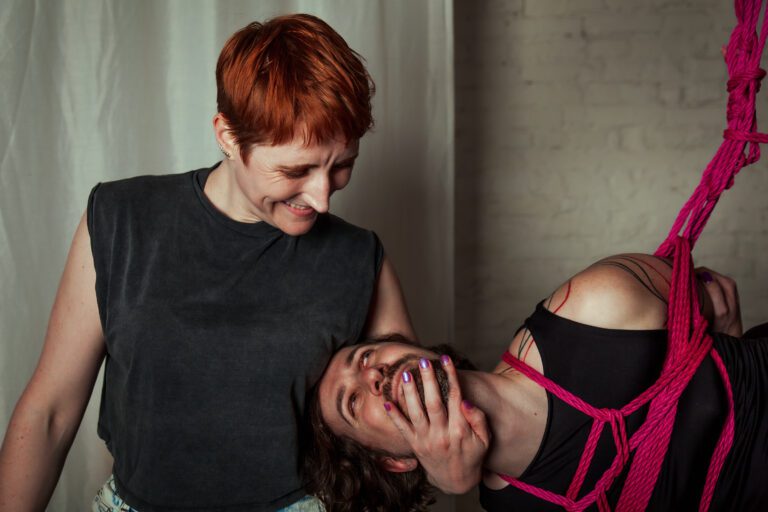
The Forgiveness Principle
by Addie Tahl (published 2016)
A while ago I told someone about an injury I sustained while in rope, one that has never healed and which I still work around, years later. Their response was “you must be pissed.” Truth is, though, I wasn’t upset when it happened, and I’m not upset now. I don’t think being mad really crossed my mind. I knew this person well, knew their honesty and their ethics, their attention to detail, knew that they were playing within their level of experience, as was I, and we went into that scene together as a team. It was an accident, pure and simple, and life goes on. I wasn’t mad because I knew them, I trusted them, and so I forgave them.
Play with people you can forgive.
The forgiveness principle says to trust people (and situations) only insofar as you will be able to fully and openly forgive that person for those consequences if the situation/scene goes south. It is an active process which entails knowing the realistic and possible worst-case scenarios, physically and emotionally, for the scene you are considering, and asking yourself if you can let that particular person (and yourself) off the hook if that happens. If you’re like me, the answer to that will depend on how well you know and trust the person in question. All else being equal, I could forgive a major injury from a partner I know and trust much more easily than I could forgive a relatively minor injury from a stranger. The forgiveness principle is what congealed when I sat and thought about why I wasn’t mad about a nerve injury, and it has become my rule of thumb when considering kink, risk, partners, and play.
The three main factors in the forgiveness principle are intention, execution, and skill. I’m going to delve into those using the example of my two hypothetical play partners, X and Y. Please note, X and Y could be tops or bottoms. I switch, I apply the same principle with everyone I play with, and I certainly hope that they do the same to me.
Intention:
I trust X because I know X very well, I have for years, we’ve played together and done some truly bizarre stuff together. When things fell apart we picked up the pieces, and when things went right it was amazing. We have a wealth of trust and positive energy to draw on. I’m confident that X is being open about their intentions, and that I can trust them not to abuse any power they hold over me. X is good stuff.
I don’t know Y, I just met them, they are still a blank slate. I don’t trust Y with much, not because I am suspicious and mean, but because there are risks associated with giving people certain types of trust, and I don’t have any previous positive data to draw on to tell me whether this person is trustworthy, or to offset the angst if something goes sour. I would shake Y’s hand, no prob, as that costs me nothing. I would not give Y significant power over me (physical like restriction or suspension, emotional like sexy floor bondage that gets my panties all messy) because if I am wrong and Y turns out to be either incompetent or an asshole this could cost me big time. This doesn’t mean Y is by default a bad or incompetent person, or that I am by default a prude. It means I weigh my risks vs benefits a certain way with people I don’t know well. I look hard at what it would cost me if I miscalculated, and, especially with blank slates, I err on the conservative side. After all, when I’m playing I want to let go and enjoy, not watch my back.
Execution:
Poor execution trumps best intentions, because intentions don’t actually determine how we feel during a scene. We are all of us fallible humans who screw up at times, and the ‘screw up’ is the part that actually affects our partners. Again, the better I know and trust a person the more I am willing to forgive a screw up. I would forgive a pretty serious misjudgment from X, because I can be confident the mistake was an honest one. I may or may not forgive Y because I don’t know Y well enough to be confident that Y wasn’t pushing the envelope or playing fast and loose with my comfort zone.
So how does Y become and X? We start slow, with little things that wouldn’t cost either of us if they go wrong (because there is a cost for both parties, and both parties should be aware of that going into any scene). I will let pretty much any ‘blank slate’ person put a wrist cuff on me, or lab a basic tie on the ground in a public space. What’s the worst that can realistically happen, and is that a risk I am willing to take? In the balance of things, I’m probably fine with it. As I get to know someone better I will be more willing to take risks on them, because I have more data on which I can base decisions (vet, people!).
Skill:
I trust X’s intentions. I trust them to play within their skill level, and as long as they are playing within their skill level I am probably going to forgive things that go wrong, because things that go wrong are probably mistakes (yes, mistakes happen, no one is infallible or psychic) or pure freak accidents (suddenly, an earthquake!). This doesn’t mean that X is by necessity a masterfully skilled kinkster, it just means that they know what they know, play within their skill range, keep their ego in check, and take my safety seriously. Also, I am going into this with eyes open. There is no ‘safe’ kink, there is ‘safer’ kink. Like condoms, sometimes a rope breaks, and this can have lasting consequences (usually more for one party than the other). So as long as I can trust my partner to play reasonably, I am willing to forgive mistakes and freak occurrences. That said, if I fall and dislocate my shoulder because someone was being negligent or tying above their level – well now I’m pissed.
Of course, people need to try new things in order to learn and grow. But there is a difference between X practicing and taking calculated risks with a partner who has been informed and has consented, and Y launching something flashy and dangerous and unpracticed that someone did the other day at that party and it looked really cool. X realizes that learning is a process and they owe it to their partners to take that seriously. Y is risking someone else’s safety for their sake of their ego. X has my forgiveness if something goes wrong, and Y does not.
So what does this all lead to? I want to evaluate the play I am going into, ask myself how well I know the person I am considering, what could go wrong, what it would cost me if that happened, how likely that is to happen, and whether I could wholeheartedly forgive that particular consequence from that specific person. If I don’t have a firm sense of calm confidence in this combo, then maybe I should think it over a bit. Maybe I should not play with this thing with this person at this time or in this situation. I could tone it down a bit, postpone, collaborate, vet and research more, approach someone else, or start smaller and build up to it. I don’t owe it to anyone to take a risk on them, but I owe it to myself to know why and how I decided to risk.
What about the Asshole Factor? There are always some people who will take any little piece of power or trust that is given them and will use that to their own ends, without regard for who they hurt along the way. Fuck those people. When I say that I risk only insofar as I can trust, and I choose where I trust so that I can forgive when something goes wrong, I do not mean that it I forgive and absorb the guilt when someone turns out to be an asshole. That’s on them. Unfortunately, by trusting we open ourselves up to the possibility of being hurt by an asshole, and that is never the fault of the person who trusted. The problem is that assholes shake our trust and confidence in ourselves, so especially in the case of an asshole it is comforting to be able to look back at my decisions and be able to stand behind them. I can hold someone responsible for their assholishness, and even while I deeply regret having trusted them I can still forgive myself for having made the decision to do so.
I want to clarify, before wrapping up this monstrosity, that I am not advocating the abandonment of all forms of risk in favour of knitting and cookies. Far from it. I love the rush that comes with being pushed. I love giving trust and power to someone and getting lost with them. I love doing the same to, for, with other people. What I am saying is that I choose very carefully with whom I explore a powder keg, both for their sake and mine, because if (when) it blows I owe it to both of us to get past it. I want to know, insofar as it is possible, that I am not risking friendship or sanity when I play, and that I am not taking a risk without consciously considering possible outcomes. The bottom line is that, if I do it right, I can look back calmly at the time I got my first nerve injury, or my second, or when I strained my back or tweaked my shoulder or had a panic attack in public. I know how and why I entered into those situations and can justify my decisions to take those risks, even now knowing the outcomes. I don’t want to look back on the physical and emotional bumps and traumas that are an inevitable (though hopefully small) part of kinking and feel resentment or self-doubt. I don’t want to waste the energy, or harm the friendships. I want to let things go, move on, have fun and explore and get freaky. I use this bit of mental math so that on the comparatively rare occasion when something does go wrong, I can think it through and forgive us both. I can forgive my partner because I trusted them consciously and risked ethically. And I can forgive myself, having done so.